weplay
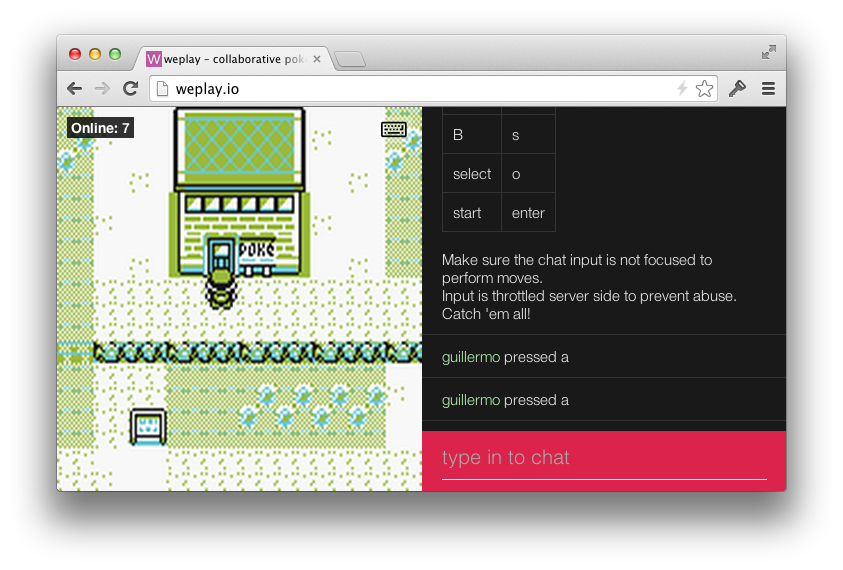
Collaborative gameboy emulation powered 100% by JavaScript
weplay
How to install
Install with
$ npm install
Then run it with the following ENV vars:
WEPLAY_PORT- pointing to the port you want to listen on (3001)WEPLAY_REDIS- redis uri (localhost:6379)WEPLAY_SERVER_UID- unique persistent identifier for this server’s
instance. Used for keeping track of # of clients in redis
(defaults toWEPLAY_PORT)WEPLAY_IP_THROTTLE- the least amount of time in ms that need to
pass between moves from the same IP address (100)
$ node index
This will set up the IO server for weplay. It’s necessary that you also
launch the other services:
- weplay-web serves the HTML
pages and static assets to run the game. It also serves initial state
from Redis with the page for optimal performance. - weplay-emulator runs an
emulator and broadcasts the image data from it with
socket.io-emitter to
the IO instance(s) that users are connected to. - weplay-presence notifies
all the IO instance(s) of the aggregate number of online users.
FAQ
How does this all work?
The weplay-emulator service
runs a JavaScript-based
gameboy color emulator
that gets painted to an instance of
node-canvas.
Upon each draw an event is emitted and the PNG buffer is piped through
Redis to all the IO instances of weplay (this project).
With Socket.IO 1.0 binary support, we can seamlessly transfer the image
data contained in the Buffer to all the connected clients, in addition
to all the JSON datastructures to make chat and commands work.
This makes weplay a 100% JavaScript project!
What are the error handling scenarios?
- In the event of a crash of a
weplayIO node, clients can be rerouted
to another instance and reconnect automatically thanks to
socket.io-client.- Events that are broadcasted to other users (such as chat messages and
“x moved y” events) get persisted upon broadcast
into a Redis capped list, which means that upon reconnection users will
get the latest events despite having been routed to a new server. - The connection count will be eventually consistent and correct thanks
to the work of theweplay-presenceservice that aggregates the
connection counts of all servers.
- Events that are broadcasted to other users (such as chat messages and
- In the event of a crash of
weplay-emulator, the next time it boots up
it restores the virtual machine state that gets persisted by default
every 60 seconds (for performance reasons).
Support
If you have ideas or contributions, join #weplay on Freenode.
License
MIT